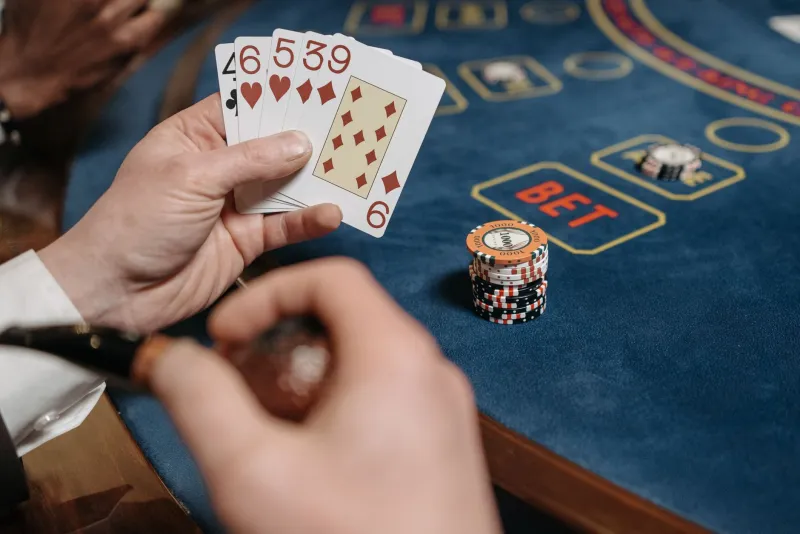
Red Zone: How the Urge to 'Get It Back' Turns Small Losses Into Financial Disasters

It starts innocently enough. You're down $80 on a Friday night, the slots aren't cooperating, and somewhere in the back of your brain a quiet voice says, just a little more and you'll be back to even. That voice? It's not your strategy talking. It's your survival instincts hijacking your decision-making—and it's the most expensive sound in gambling.
Loss-chasing is one of the most well-documented and least-talked-about traps in the casino world. Players who understand variance, read bonus terms carefully, and manage their bankrolls responsibly can still fall into this hole. Because it's not really about knowledge. It's about psychology, brain chemistry, and a deeply human refusal to accept a loss as final.
What Loss-Chasing Actually Looks Like
Here's where a lot of players get confused: not every attempt to recover losses is chasing. There's a real difference between strategic bankroll recovery and emotional desperation betting, and that line matters enormously.
Strategic recovery looks like this: You've had a bad session at the blackjack table, you've hit your stop-loss limit, and you decide to come back tomorrow with a clear head and a fresh stake. That's discipline. That's smart play.
Loss-chasing looks like this: You're down $200, so you move to a higher-stakes table to win it back faster. Or you start skipping your usual bet-sizing rules. Or you dip into money that was never part of your gambling budget in the first place. That's not strategy—that's panic wearing a strategy costume.
Real players, real scenarios: Think about Marcus, a recreational sports bettor in Atlanta who had a solid system for NFL games. After a brutal Sunday where three of his five picks lost on last-minute field goals, he doubled his stakes on Monday Night Football to "recoup the weekend." He lost that bet too, ending the week down four times what his original losses were. The picks weren't worse. The bet-sizing was catastrophic.
The Brain on Tilt: Why Your Own Mind Works Against You
Neuroscience has a lot to say about why smart people make terrible decisions after losing money. The key player here is dopamine—the neurotransmitter associated with reward, motivation, and anticipation.
When you win, dopamine floods your system. When you lose, it drops sharply. And here's the kicker: your brain registers a near-miss almost the same way it registers a win, which is why slot machines are designed the way they are. That "almost got it back" feeling keeps you in the chair when you should be walking out the door.
Beyond dopamine, there's something called loss aversion, a concept popularized by behavioral economists Kahneman and Tversky. Humans feel the pain of a loss roughly twice as intensely as the pleasure of an equivalent gain. Losing $100 hurts more than winning $100 feels good. That imbalance creates a powerful emotional drive to undo the loss—even when the rational move is to stop.
Add in cortisol (the stress hormone that spikes during losing streaks) and you've got a cocktail of brain chemistry that's actively working against your best interests at the table.
The Four Warning Signs You've Crossed the Line
Recognizing tilt in yourself is harder than spotting it in others. Here are four concrete signals that you've moved from calculated play into the danger zone:
1. You've changed your bet size without a strategic reason. If you normally play $10 hands and you're suddenly playing $50 hands because you're chasing, that's the red flag. Bet-sizing should be driven by your bankroll plan, not your emotional state.
2. You've extended your session past your pre-set time or loss limit. Every serious player sets limits before they sit down. If you told yourself you'd stop at $150 down and you're now at $300 down still playing, you're chasing. Full stop.
3. You're thinking about money you can't afford to lose. The moment rent, groceries, or bills cross your mind as potential sources of gambling funds, you're not in the casino anymore—you're in a crisis.
4. Winning feels like relief, not excitement. When the goal shifts from enjoying the game to escaping the hole, the entire emotional context of your session has flipped. That's a sign to stop immediately.
Practical Tactics to Break the Cycle Before It Starts
The good news is that loss-chasing is a pattern, and patterns can be interrupted. Here's what actually works:
Set hard stops before you play. Write down your loss limit and your win goal before your first bet. Treat them like contracts with yourself. Some players even text a friend their limits as a form of external accountability.
Build in a mandatory break trigger. Decide in advance that if you hit a certain loss threshold—say, 30% of your session bankroll—you take a 15-minute break. Get up, get water, step outside. Physical separation from the game resets your emotional state more effectively than you'd think.
Keep a session log. A simple notes app entry after every session—what you played, how much you won or lost, and how you felt when you stopped—creates a paper trail that makes patterns visible. If you look back and see three sessions in a row where you exceeded your loss limit, that's data worth taking seriously.
Separate your gambling bankroll physically. If your gambling money is in a separate account or a prepaid card with a fixed balance, you can't easily dip into other funds. Friction is your friend when emotions are running hot.
The Long Game Always Beats the Desperate Play
Here's the hard truth: no single session defines your gambling career, but a bad chase session can end it. The players who stay in the game longest—who actually build positive experiences and occasionally walk away winners—are the ones who treat each session as one chapter in a much longer story.
Losing $100 on a Tuesday night is table stakes for anyone who plays regularly. Turning that $100 loss into a $600 loss because you couldn't let it go? That's the kind of session that makes people quit gambling entirely, or worse, keeps them coming back in the wrong headspace.
At GambleTime, we're all about playing smart—and playing smart means knowing when the best move is no move at all. The casino will be there tomorrow. Your bankroll needs to be too.
The comeback you're looking for isn't found in the next spin or the next hand. It's found in the decision to stop, reset, and come back ready to play your game—not chase someone else's ghost.